
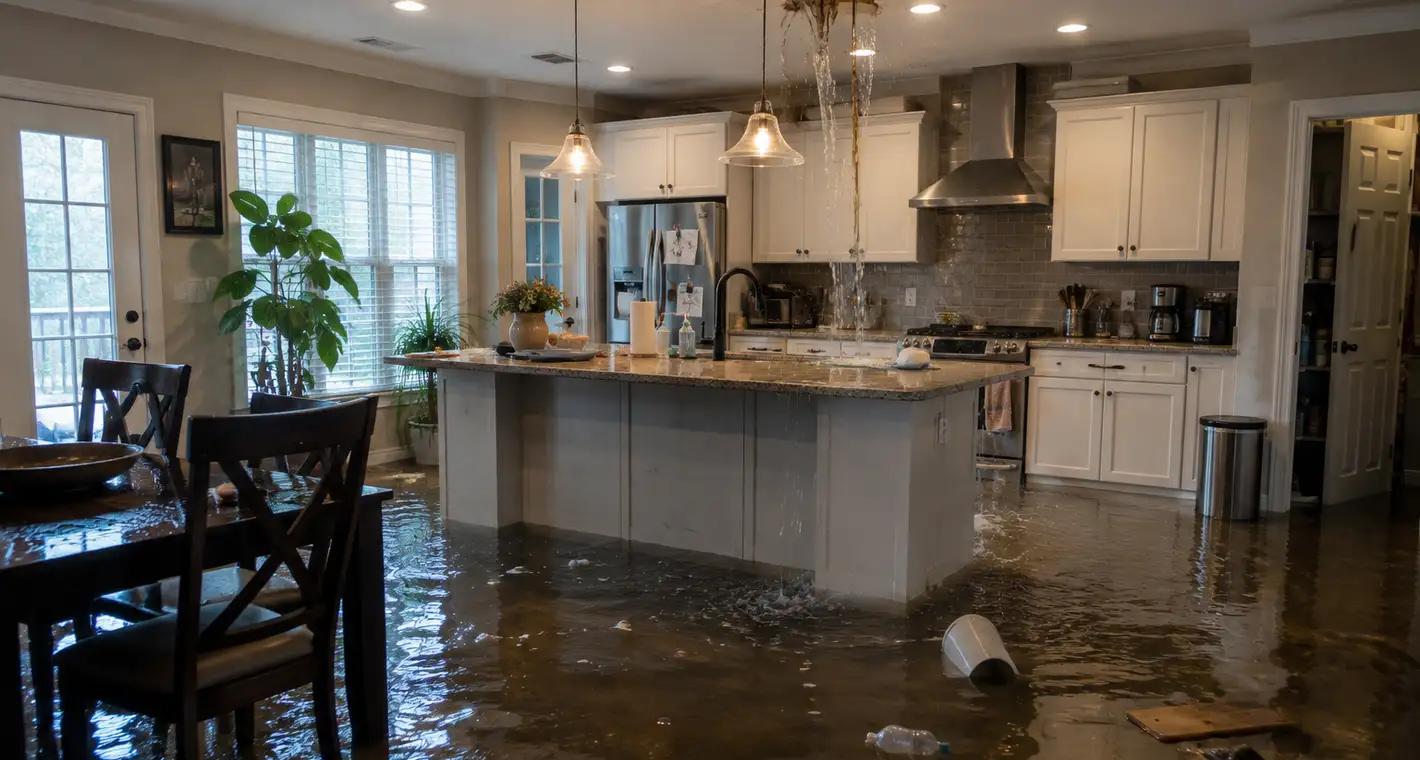
Water damage in Hewitt
Hewitt lies immediately southwest of Waco along the Hewitt Drive and Old Temple Road corridors, on flat Blackland Prairie ground between Woodway and Lorena.
Almost all of Hewitt is post-1980 residential construction on slab-on-grade foundations, with heavy subdivision building through the 1990s and 2000s and continuing along the southern edge of the city.
Before help arrives
- Shut the water off at the fixture or the main if you can reach it safely.
- Keep out of any room where water has reached outlets, cords, or the electrical panel.
- Lift furniture off wet carpet and move what you can to a dry floor.
- Photograph the damage and the failure point before anything is moved.
- Do not use a household vacuum to pick up standing water.
Common causes in Hewitt
Polybutylene and early plastic supply lines
Subdivisions built from the late 1970s to the mid 1990s frequently used polybutylene supply piping, and the acetal fittings degrade from the inside where chlorinated water contacts them. Failures are sudden rather than gradual and often happen at a fitting inside a wall. In a Hewitt house of that vintage the line may run through the attic, so a break drains through ceiling and insulation before it reaches the floor.
Slab movement across newer subdivisions
Rapid subdivision building put a great many slabs onto the same expansive clay in a short period. Where lots were cut and filled to level a street grade, the clay under one corner of a house can behave differently from the clay under another. Differential movement stresses the plumbing cast into the slab, and it is a common reason a fifteen-year-old home develops a slab leak while its neighbour does not.
Water heaters in attic platforms
With no basement and no garage space to spare, builders often set the water heater on a platform in the attic. A tank that fails there empties through the ceiling rather than onto a garage floor, and the drain pan under it helps only if its line is clear and correctly routed. Tanks here tend to fail earlier than rated, because the water carries enough mineral content to scale the element and the tank bottom.
Yard drainage that runs toward the house
Flat clay ground sheds water slowly, and a graded lot settles over time as the clay cycles. On a street of similar houses it is common to find one where the ground has moved enough that runoff now collects against a wall instead of leaving the lot. Slab construction sits close to grade, so a few inches standing along the foundation reaches the sill plate and the wall base directly.
Drying a Hewitt home
Hewitt housing is consistent enough that drying follows a familiar pattern: post-1980 slab construction with modern drywall, carpet over pad in bedrooms and glued or floating hard flooring in living areas. The hard flooring is what hides water here, since a floating plank floor lets water spread across the slab beneath while the surface stays convincingly dry underfoot.
The sequence does not change from house to house: extraction first, then air movers and dehumidifiers together, with readings logged daily until materials match the dry baseline for that building. It is described in full on the water extraction and drying page.
Services available in Hewitt
- Water Extraction & DryingStanding water removal and controlled structural drying under moisture readings.
- Slab Leak DamageWater surfacing through a slab-on-grade foundation, located and dried out.
- Sewage CleanupContaminated water handled with containment, removal and cleaning.
- Mold RemediationGrowth that established after water sat longer than it should have.
- Burst pipe and supply line cleanup
- Water heater and appliance leak cleanup
- Ceiling and drywall water damage
- Moisture inspection and mapping
Areas covered in Hewitt
Providers cover Hewitt and the surrounding area, including Warren Park, Spring Valley, Hewitt Drive corridor, Sun Valley, Chapel Road, Old Temple Road and Panther Way.
ZIP codes: 76643.
Frequently Asked Questions
- Will my homeowners insurance cover water damage?
- It depends on the cause rather than the damage. Policies commonly cover sudden and accidental events such as a burst supply line or a failed water heater. Damage that developed gradually from a long-standing leak, and damage from surface flooding, are typically excluded. Photograph everything before it is moved, keep any failed part, and report the loss promptly.
- Should I turn off the electricity?
- If water has reached outlets, cords, appliances, or the panel itself, treat the area as unsafe. Only shut off the breaker if you can reach the panel without standing in water. If you cannot reach it safely, leave the area and have the utility or an electrician handle it.
- The water heater is in my attic. What should I check?
- Three things: that a drain pan is actually installed under the tank, that the pan drain line is clear and discharges outside where you will notice it, and that the tank is not past its service life. Water in this area scales tanks faster than the rated life assumes. An attic tank failure is one of the more damaging residential losses because the water passes through ceiling, insulation and wall cavities on its way down.
- Can a slab leak be found without breaking up the floor?
- Usually the location can be narrowed down non-destructively first. Providers isolate the supply system to confirm the leak is on a pressurised line, then use acoustic listening equipment and thermal imaging across the floor to find where water is moving under the concrete. Opening the slab comes after the location is established, and in some cases the line is rerouted overhead instead so the slab is not opened at all.
- Does the age of the subdivision change how the work is scoped?
- It changes what is likely behind the surface. Houses from the 1980s and early 1990s may hold polybutylene supply lines, older insulation, and flooring that has been replaced over an original layer, and layered flooring traps water between the two. Newer construction along the southern edge of the city is generally PEX with a straightforward assembly, which makes the moisture path easier to map.
- My Hewitt house was built in the early 1990s. Is polybutylene something to check?
- It is worth confirming. Grey flexible supply pipe with crimped fittings, visible at the water heater connections or where lines enter from the attic, points to polybutylene. It was used widely in that period and the failures tend to be abrupt rather than a slow drip. Knowing which system you have also matters at the moment of a loss, because it tells you whether an isolated repair or a whole-house repipe is the sensible response.