
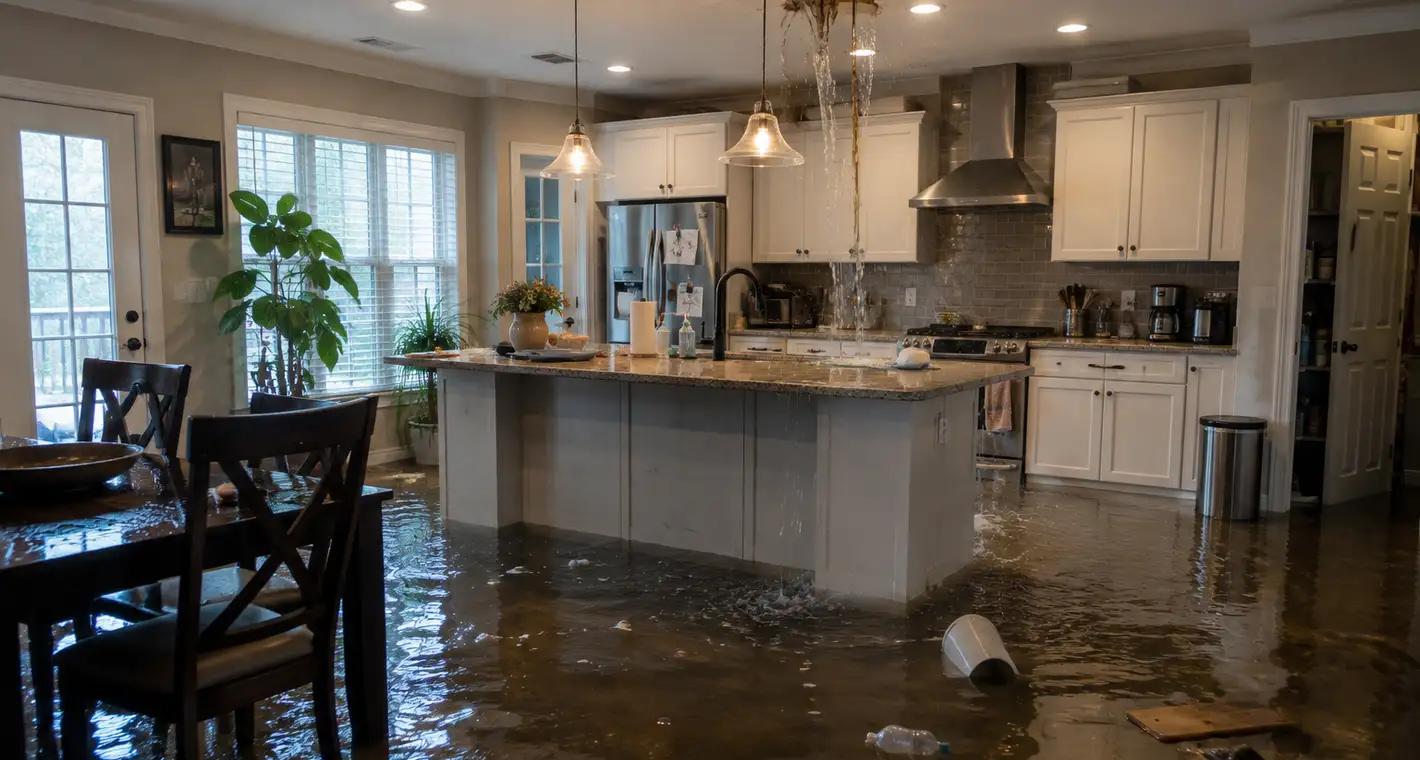
Water damage in Bellmead
Bellmead sits northeast of Waco between the Brazos River and Interstate 35, on low flat ground close to the river bend and the Lake Brazos stretch.
Much of the city was built out in the 1940s through the 1960s as modest single-storey housing, and a good portion of that original stock is still in service, with a mix of slab and pier-and-beam foundations.
Before help arrives
- Shut the water off at the fixture or the main if you can reach it safely.
- Keep out of any room where water has reached outlets, cords, or the electrical panel.
- Lift furniture off wet carpet and move what you can to a dry floor.
- Photograph the damage and the failure point before anything is moved.
- Do not use a household vacuum to pick up standing water.
Common causes in Bellmead
Galvanised supply lines at the end of their life
Houses from the 1940s and 1950s were plumbed in galvanised steel. It corrodes from the inside, narrowing the bore and thinning the wall at threaded joints, which is where it eventually splits. Failures cluster by age rather than by household, so a street of similar houses tends to see them within a few years of one another. Reduced pressure and rust-coloured water are the warnings that come first.
Low ground close to the river bend
Bellmead sits on some of the lower ground in the metro area, close to where the Brazos turns past Waco. Local storm runoff has a short distance to travel and little fall to travel it on, so streets and yards hold water during heavy rain. Slab houses here sit only a few inches above grade, which leaves very little margin between water standing in a yard and water inside the house.
Original sewer laterals under moving clay
Laterals installed seventy years ago in clay pipe have spent that entire time in soil that swells and shrinks with every wet and dry cycle. Joints work open, sections offset, and roots follow. A restricted lateral shows up as slow drains across the house and then as a backup at the drain closest to the floor, and everything that surfaces that way is contaminated.
Freeze damage in shallow and exposed plumbing
Older construction here predates any expectation of a hard multi-day freeze. Supply lines run through uninsulated crawl spaces, along exterior walls and to hose bibbs without frost protection. In February 2021 that combination produced burst pipes across a third of area households, and the houses that failed were disproportionately the older, less insulated ones.
Drying a Bellmead home
The older housing stock here dries differently from a modern subdivision. Thinner walls and less insulation mean the assembly gives up moisture relatively quickly once it is opened, but layered flooring is the recurring complication: vinyl laid over older tile over the original slab traps water between the layers and reads dry at the surface while the slab underneath is still wet.
The sequence does not change from house to house: extraction first, then air movers and dehumidifiers together, with readings logged daily until materials match the dry baseline for that building. It is described in full on the water extraction and drying page.
Services available in Bellmead
- Water Extraction & DryingStanding water removal and controlled structural drying under moisture readings.
- Slab Leak DamageWater surfacing through a slab-on-grade foundation, located and dried out.
- Sewage CleanupContaminated water handled with containment, removal and cleaning.
- Mold RemediationGrowth that established after water sat longer than it should have.
- Burst pipe and supply line cleanup
- Water heater and appliance leak cleanup
- Ceiling and drywall water damage
- Moisture inspection and mapping
Areas covered in Bellmead
Providers cover Bellmead and the surrounding area, including Old Dallas Highway, Bellmead Drive, Loop 340 corridor, North Bellmead, Hillcrest, Connally area and Airport Road.
ZIP codes: 76705.
Frequently Asked Questions
- Will my homeowners insurance cover water damage?
- It depends on the cause rather than the damage. Policies commonly cover sudden and accidental events such as a burst supply line or a failed water heater. Damage that developed gradually from a long-standing leak, and damage from surface flooding, are typically excluded. Photograph everything before it is moved, keep any failed part, and report the loss promptly.
- Should I turn off the electricity?
- If water has reached outlets, cords, appliances, or the panel itself, treat the area as unsafe. Only shut off the breaker if you can reach the panel without standing in water. If you cannot reach it safely, leave the area and have the utility or an electrician handle it.
- How do I know if my supply lines are galvanised?
- Look where the piping is visible, at the water heater, under a sink, or where a line enters the house. Galvanised is dull grey steel with threaded fittings, and a magnet sticks to it, which it will not do to copper or plastic. Falling pressure at the fixtures and brown water after the system has been off for a while both point the same way. In a house of this age it is a reasonable assumption until proven otherwise.
- Should anything be tested before demolition in an older house?
- Yes. Building materials used in this period can contain asbestos, particularly in floor tile, tile adhesive, and some textured or joint compounds, and paint from that era may contain lead. Where those materials are affected, they need to be identified before they are disturbed, since cutting or sanding them is what creates the hazard. It is a scoping question that comes up early rather than a reason the work cannot proceed.
- Drains across the whole house are slow. Is that a water damage issue yet?
- Not yet, but it is the warning stage. When several fixtures slow at once the restriction is usually in the lateral rather than at any one drain, and the next step in that sequence is a backup at the drain closest to the floor. Having the line cleared and camera-inspected while the drains are merely slow is the difference between a plumbing bill and a contaminated water loss.
- My house is from the 1950s. Does its age make water damage worse?
- It changes the risk rather than simply raising it. Older plumbing fails more often, which is the main difference. Against that, the walls are usually simpler and less insulated, so they dry faster once the wet material is removed. The complications tend to be layered flooring hiding water at the slab, original clay laterals that back up, and materials from that era that need to be identified before anything is cut or demolished.